
Over the last couple of weeks I have written about the sorts of questions doctors consider when it comes to palpitations, and the tests we do to investigate them. This week, I’ll talk about some of the causes.
Clearly this is a big topic, so to split it up, I’ll divide them by the area of the heart where they originate. First though, we need to understand how the electrical conduction system of the heart works. The image below shows this in cartoon form. The sino-atrial node (SA node for short) starts things off by generating an electrical impulse, which then travels through the tissue of the right atrium before arriving at the atrio-ventricular (A-V) node. From here, the electricity travels in a series of ‘wires’ (shown in yellow below). Think of this a bit like the solder on a circuit board. This ‘wires’ are called purkinje fibres, which have branches through the ventricles (the main pumping chambers). As the electrical signal passes through the heart, it causes something called depolarisation, which stimulates the heart muscle cells to contract.
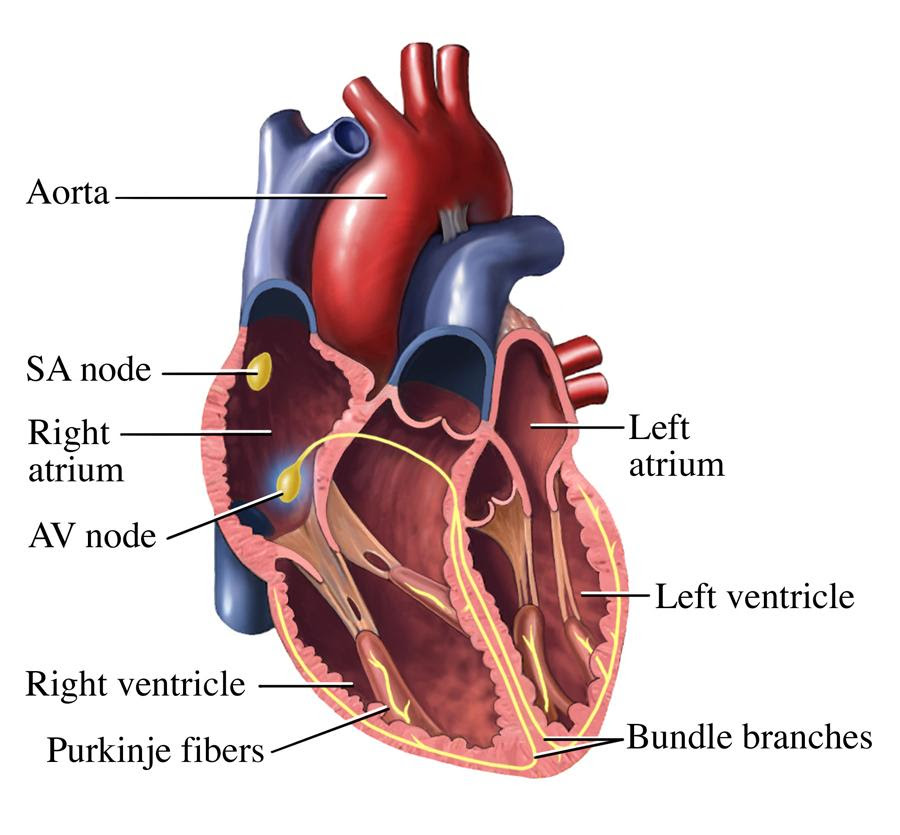
Palpitations caused by fast or irregular heart beats are often divided into those that start in the atria, and those in the ventricles. The medical term for the former is ‘supra-ventricular tachycardias (SVT, or literally – above-the-ventricles-fast-heart-beat).
Using the diagram above, fast heart rates from SVTs could some from –
- The SA node – This is what happens if you do exercise and is called sinus tachycardia, but could also be abnormal – inappropriate sinus tachycardia
- The atrial tissue – Either right or left atrium – this may be an atrial tachcardia
- The left atrium pulmonary veins (more on this in a later post, as this is atrial fibrillation a very common condition and deserving of much more information…
- An area of tissue between the right atrium and right ventricle – atrial flutter
- The AV node or nearby – junctional tachycardia, AV nodal re-entrant tachycardia or AV re-entrant tachycardia – I think differentiating between these is hard enough for doctors so doubt I will go into it in my posts!
Fast heart rates from the bottom chambers of the heart include:
- Ventricular tachycardia (VT)
- Ventricular fibrillation (VF)
- SVT which has been conducted abnormally (also complicated and beyond the scope of this post)
Lastly, patients may experience ventricular ectopic or supra-ventricular ectopics (the word ectopic simply means ‘coming from somewhere it shouldn’t).
I hope this makes some sense to you. It is a complicated topic, but I believe if you have a better understanding of the mechanism behind a heart beat, it is much easier to understand what happens when patients experience palpitations.
More on this next week!