
Last week I explained how the electrical conduction system of the heart works, so now it’s time to see what happens when it misbehaves!
I expect everyone has experienced a palpitation at one time or another, I know I certainly have! There are many causes, but one of the commonest is ectopic heart beats. As I wrote last week, the word ‘ectopic’ just means coming from somewhere it shouldn’t. For example, an ectopic pregnancy is a fertilised egg lodged somewhere other than the uterus such as in a fallopian tube.
In the case of an ectopic heart beat, this is a beat originating somewhere other than the yellow ‘wires’ on last week’s diagram of the electrical system. If it is in the atria, we call this a ‘supra’ ventricular ectopic (supra means above, and the atria are located above the ventricles), and if in the ventricles, a ‘ventricular’ ectopic.
There are many causes, common ones include stress, alcohol, smoking, thyroid problems, caffeine, carbonated drinks, underlying structural or ischaemic heart disease, but sometimes there is no obvious reason as to why they occur. They may happen as isolated heart beats, or may come in runs of 2, 3 or more.
They may last for a second or two, or hours, or days, or weeks, or months….
It is important to know how many there are in a 24 hour period, as if there are a very large number, this can affect the pumping function of the heart, and in the worst case scenario cause heart failure. Thankfully this is quite rare.
In my case, I have had them on about 3 occasions, each time for a few hours, and (thankfully!) they disappeared on their own. Here is my apple watch tracing at the time of one episode:
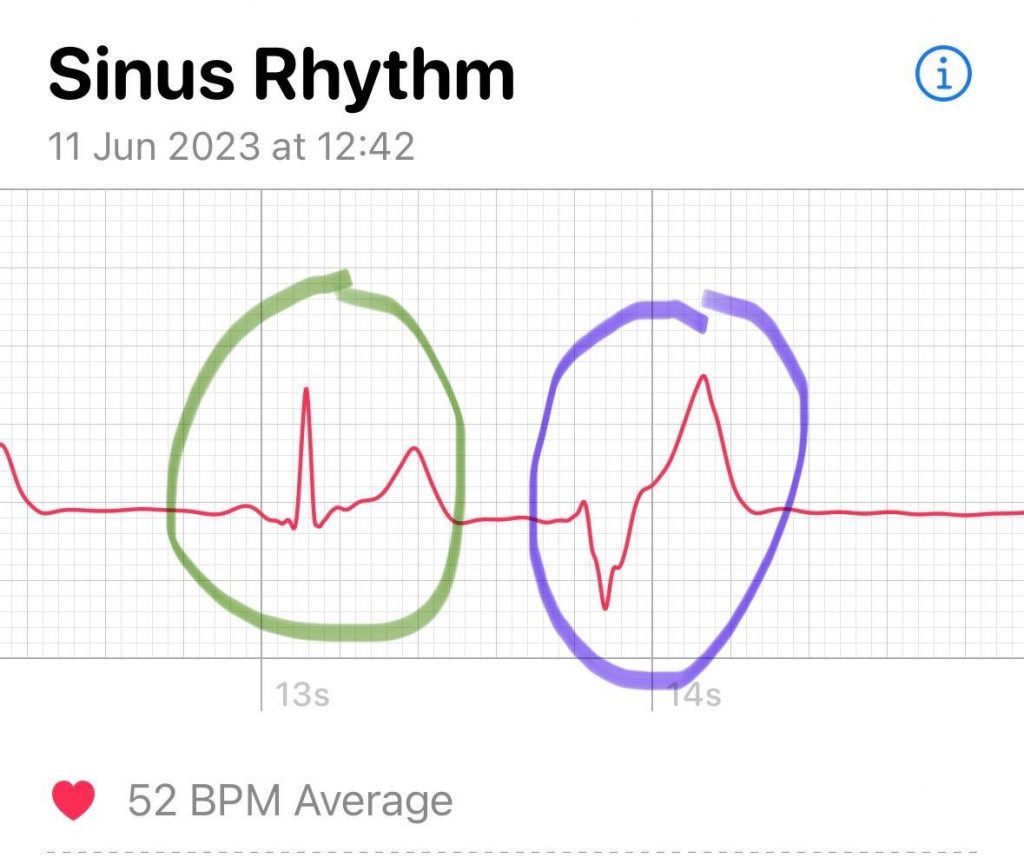
I have highlighted a normal beat in green, and the ectopic in purple. You will notice that the ectopic looks completely different, and that is because it originated in the heart muscle of the ventricles, and so did not use the specialist electrical conduction system of the heart. I can tell you that I felt really awful at the time, and definitely would have been seeking medical advice if I wasn’t a Cardiologist!
Quite commonly, after a ventricular ectopic beat there is a pause. It’s as if the heart momentarily forgets what it is doing and takes a second or two to remember and beat again. This can be associated with feelings of dizziness or light-headedness if it goes on for long enough.
Typically ventricular ectopic beats are more ‘powerful’ and feel more forceful than supra-ventricular ectopics. This may be because the ventricles are stronger and contract with more ‘oomph’. If they happen to occur when the pulmonary valve (outlet valve of the right ventricle) is closed, this can have the effect of forcing the pressure up into the neck, which is where the sensation can sometimes be felt. I can tell you it was most unnerving in my case!
In addition to a heart monitor, it is often sensible to check that a patient’s heart is structurally normal. This involves doing an echocardiogram, or heart ultrasound. This will make sure there is no abnormality contributing to the ectopics, and also may have a bearing on treatment.
In terms of treatment, this can vary. If there is an obvious trigger, then avoiding the trigger is usually all that is needed. I have found that I sometimes get minor symptoms when I exercise a lot and get sweaty, most likely as I am losing salts and electrolytes and thereby increasing the chances of ectopics. To combat this, I use electrolyte replacement powder in my water bottle, which has sorted the problem. I advise the same thing to my patients in that scenario. If needed, medications can be prescribed. These include drugs such as beta blockers, rate-slowing calcium channel blockers, and on occasion more specialist drugs such as flecainide. These can be taken ‘as and when’ for infrequent symptoms, or more regularly if patients have symptoms that need that.
I hope this has been interesting and useful. I expect everyone reading has had ectopics at some point or another, so hopefully relevant to all. Please remember though, if you do have symptoms, whether you see me or another healthcare professional, do get them checked out. Whilst ectopics are mostly a fairly benign phenomenon, they can be indistinguishable from more serious heart rhythm issues.
If you haven’t already done so and would like to submit a topic for ‘ask me anything’ please do so, and I will be addressing the most common topic submitted this week. Thanks to all those who have already done so.
I’ll leave it there for this week – I’ve got a Christmas tree to decorate!