
There are occasionally times when patients crop up and you really need to think that little bit harder to work out what to do, and this case is just such a time. Some heart rhythm disturbances can be fatal, and this particular one can be, but is really rather rare. To help you understand the heart’s electrics in more detail, please see my video ‘the heart’s electrical system explained’ where I demonstrate the set-up using a model. However, in case you haven’t yet seen it, imagine a circuit board in your mind, with wires carrying the electricity.
In a normal heart, the electricity flows in these wires from top to bottom, and as it passes through the muscle, the muscle contracts. Evolution has designed the system to stop it contracting too fast, with various checks and balances in place accordingly. My maximum heart rate for example is 182 currently, no matter how much effort I put in on my bike (and I could only sustain a truly maximum effort for around 20 seconds).
However, some patients have an additional electrical pathway, and as such a ‘short circuit’ can occur. Picture an additional wire running top to bottom of the circuit board, which is capable of conducting electricity far more quickly than the wire the heart is supposed to use. These additional ‘pathways’ (as they are known) can either be congenital, ie present from birth, or acquired, meaning they develop later in life. In my patients case, he was in his early 70s (which is quite late for this sort of thing, in fact he’s the oldest person I can recall seeing with it).
One issue with the extra wire, is that it is not subject to the same checks and balances, so the heart might go up to as much as 300 beats per minute! Clearly that it not compatible with being conscious, and often patients black out if it goes that fast, or in the worst case scenario the rhythm deteriorates further and they have a cardiac arrest and die. My patient had indeed blacked out.
There are clues on the ECG (paper tracing of the heart) – we call these ‘delta waves’. In the image below I have circled some. Time is on the horizontal axis, so we are seeing the conduction of the electricity via both the normal wire, and the extra fast one, ‘blurring’ the complex on the paper trace.
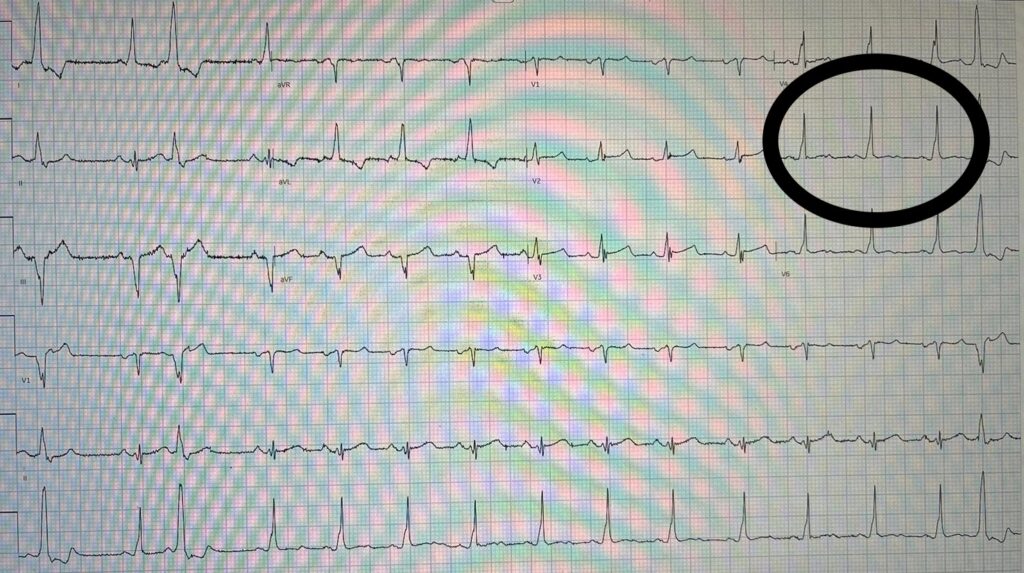
One has to be very careful here: in most cases of heart rhythm disturbances going too fast, we give a drug to slow the heart rate down. However with an extra electrical pathway, most drugs to slow the heart only slow the normal wire, leaving the fast one unimpeded and the patient may conduct at extremely high rates and have a cardiac arrest. Remember I said I needed to think that little bit harder! It’s good to be kept on your toes!
In the fullness of time, ablation is a very effective treatment for this condition, as the fast pathway can be essentially destroyed. The ECG returns to normal, the ‘delta wave’ disappears, and the patient is safe once more.
I hope you found this case interesting! Please do check out the accompanying video too