
You may know I’m a keen Arsenal fan, so whenever a story crops up involving the club I tend to take a look, and so it was this week with former Gunners mid-fielder Jack Wilshere. He is a British Heart Foundation ambassador, having been on a long journey with his young daughter who had surgery to repair a hole in her heart. As sad as these stories are sometimes, having a high profile person championing a worthy cause is often an upside in terms of increasing awareness of such problems. Happily in Jack’s daughter Siena’s case, she was a ‘warrior’ and has done really well.
The term we use to describe a heart problem from birth is ‘congenital heart defects’ and there are a great many of them; too many to go through in detail and many are not very relevant to the average reader. I thought it would be worth however covering some of the basics, which are common enough that you might know someone, or have heard of someone, who has one. Overall, 1% of babies in the UK are born with some form of congenital heart defect. Many years ago these conditions could be fatal, but thankfully now can often be corrected in some way.
The heart and its major blood vessel connections form in the first 6 weeks of pregnancy, and so it is this time when issues many start to arise. In simple terms, there can be problems with the connections between the heart and other organs (for example the pipes take blood to the wrong side of the heart), problems within the heart itself (a hole which allows mixing of oxygenated and de-oxygenated blood) and problems with the valves (similar to adult valve disease). All of these issues may adversely affect the ability of the body to deliver enough oxygen to the other organs, and also increase the pressure in the lungs. Sometimes abnormalities are isolated, sometimes they occur in combination with others.
Why do congenital heart defects occur?
There are a number of risk factors which may be at play. Some are genetic, and conditions run in families. The commonest is Trisomy 21 (Down Syndrome) where heart issues are very common. German measles (Rubella) in early pregnancy increases the risk, as does poor diabetes control (although not pregnancy-induced diabetes). Certain medications: many will have heard of the thalidomide catastrophe, where the drug was marketed for morning sickness but was associated with some awful birth defects, but other common drugs which should be discontinued include statins, ACE inhibitors, some acne and epilepsy medications for example. Smoking and alcohol are likely contributory also.
Children with congenital heart disease are often diagnosed at a young age, and of course are unable at that age to describe symptoms. They are often therefore picked up by a ‘failure to thrive’, breathlessness or more serious issues such as heart failure, heart infections, or serious arrhythmia.
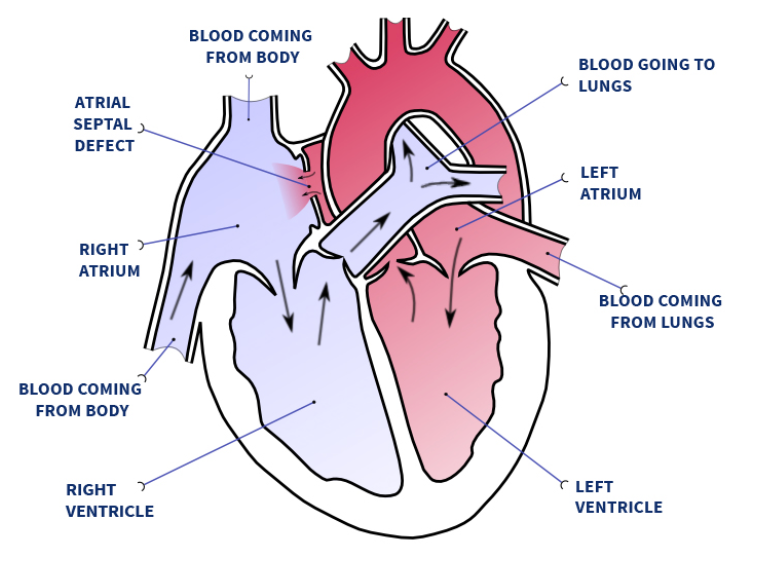
Jack’s daughter Siena I gather had a cough that just wouldn’t go away (I’m speculating but this may have been down to high pressure in her lungs – called pulmonary hypertension). She had a condition called a sinus venosus atrial septal defect, which is a hole in the top part of the heart. They are a rare subset of holes in the heart (a generic ‘catch-all’ term but is actually fairly accurate!). As a result, higher pressure blood full of oxygen is forced across the hole from left to right. This often causes the right heart to swell, and untreated, can cause heart failure and death. Surgical repair can resolve this problem, but it must be identified early enough to avoid complications. A diagram demonstrating where in the heart an atrial septal defect arises is shown below.
I will add specific sections on each congenital heart defect in due course to the members area, but hope for today this has provided an interesting overview of congenital heart disease. I wish the Wilsheres all the best.