
Exercising Safely, Performing at Your Best
Whether you’re a competitive athlete, a weekend club player, or getting back into exercise after years away — is your heart keeping up with what you’re asking of it, and is it safe to push harder?
About this service
I’m Dr Chris Critoph, a Consultant Cardiologist based in Bournemouth with a specific interest in sports cardiology. My MD (Res) research degree, awarded by University College London in 2014, used cardiopulmonary exercise testing (CPET) to study patients with inherited heart disease — work that sits at the intersection of exercise physiology and cardiology. I’m also a keen sportsman myself: I practice what I preach when it comes to fitness, training 6 days per week with a mixture of strength based work, zone 2 and VO2 max sessions, alongside active recovery, pilates and golf.
What is sports cardiology?
Sports cardiology sits between cardiology and sports medicine. It covers the heart-related questions that come up specifically around exercise and athletic performance — questions a standard cardiology check-up isn’t necessarily set up to answer. Broadly, that covers three groups of people: those who’ve developed symptoms during or after exercise and want to know why; those with a known or suspected heart condition who want to know what exercise is safe for them; and those without symptoms who simply want an objective, accurate measure of their fitness or a safety check before increasing training intensity.
Common reasons people see me
Breathlessness or symptoms during exercise
If you get more breathless than expected during exercise, or notice chest tightness, palpitations, dizziness or unusual fatigue during or after exertion, a proper assessment can distinguish a heart problem from a lung problem, general deconditioning, or something else entirely — see also my shortness of breath and palpitations pages.
“Athlete’s heart” — is this normal, or is it a problem?
Regular intensive training can change the heart — often making it larger, thicker-walled, or slower-resting than average. In an athlete, most of these changes are a normal, healthy adaptation to training, not disease. But some of the same features can, in certain patterns, be an early sign of an underlying heart condition. Telling the difference between the two is a core part of sports cardiology, and often needs more than a standard ECG alone — sometimes an echocardiogram, a CPET, or a period of monitoring, interpreted by someone used to reading tests in the context of an athlete’s training load, not just population-average ranges.
Getting back to sport after a diagnosis, procedure, or cardiac event
If you’ve been diagnosed with a heart condition, had a cardiac procedure, or had a cardiac event, deciding what exercise is safe, and when, and how, to return to your sport, is a specific, personalised discussion, not a blanket rule. This applies whether you’re returning to five-a-side football or training for an ironman.
Masters and veteran athletes
More people are training seriously, and competing, well into their 50s, 60s and beyond — a group I have a particular interest in, being one myself. Increasing training volume or intensity later in life, especially after a gap, is a reasonable time to check that your heart is keeping up with what you’re asking of it, particularly if you have any personal or family cardiac history.
Cardiopulmonary Exercise Testing (CPET)
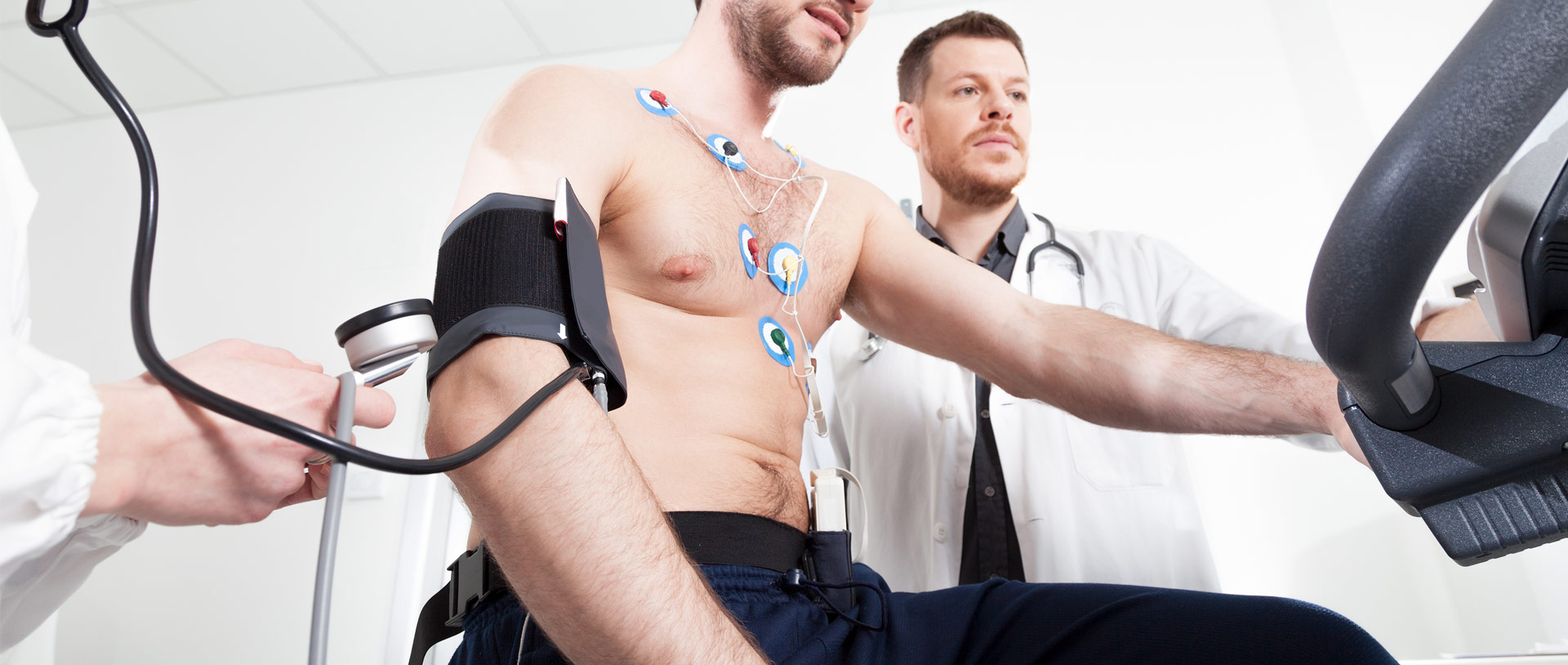
Cardiopulmonary exercise testing (CPET) is a non-invasive investigation used to assess the performance of the heart and lungs at rest and during exercise. It’s similar to a standard exercise test, but with some important differences, and gives doctors a lot more information. CPET is used in different areas of medicine — for example, in patients scheduled for major surgery, to give doctors an idea of the risk, and to understand whether a patient’s symptoms are due to a heart problem, a lung problem, generalised physical deconditioning, or something else.

It’s also used in the world of sports physiology, as it gives an objective, accurate measure of someone’s fitness (their peak VO2). For example, a cyclist might have a test pre-season, then monitor their progress and fitness by repeating it after a period of training. Many common wearable gadgets, such as Garmin and Apple watches, try to estimate VO2 to help amateur athletes gauge their fitness. These devices make a number of mathematical assumptions, so while sometimes not bad, they’re certainly not completely accurate.
What does the test involve?
During the test, you exercise on an upright bicycle while breathing through a mouthpiece. Each breath is measured to assess how your body is performing, analysing oxygen and carbon dioxide levels. Lung capacity and strength are measured before and during exercise, and your heart tracing (ECG) is recorded before, during and after exercise. The test requires maximum effort to ensure the most reliable diagnostic information.
What’s analysed:
- Lung function (flow volume loops)
- Oxygen consumption during exercise (VO2 max)
- Anaerobic threshold
- Heart performance during exercise
- Exercise 12-lead ECG
Once you’ve had your assessment, I meet with you personally in clinic to go through the results. If you’ve had the test to investigate symptoms, we look at what might need to be done and formulate a treatment plan. I can also advise on what sort of exercise might benefit you from a heart point of view, and what sort should be avoided — and if you’re an athlete, we discuss what the results mean for your training.
A cardiologist who practices what he preaches

Leaving London for Dorset wasn’t only a good career move — it gave me far more opportunity for my other great passion, sport. Swapping the commute through central London for treks around the New Forest and the Purbecks was a great start; joining Parkstone Golf Club made the move a complete no-brainer. The only downside was giving up my season ticket at the Emirates to watch Arsenal. I am passionate about sport and it has been a fundamental part of my life since childhood, as it is for my own children now. Although I no longer compete, I plan my own exercise regimen to train for what I want to continue to do for decades yet — ski, climb mountains, and be strong and independent in my 80s and ideally beyond.
Who this might be for
- You get breathless, or notice other symptoms, during or after exercise
- You’ve been told you have “athlete’s heart” changes and want to know if that’s really all it is
- You have a known heart condition and want clear guidance on what exercise is safe
- You’re returning to sport after a cardiac diagnosis, procedure, or event
- You’re increasing your training as a masters/veteran athlete and want a safety check
- You simply want an accurate, objective measure of your fitness (VO2 max) rather than a wearable’s estimate
Where I see patients
Consultations and CPET take place at Nuffield Health Bournemouth and in Poole. Initial consultations are also available by phone or video for patients anywhere in the UK; CPET itself requires an in-person visit.
Frequently asked questions
I’ve been told I have “athlete’s heart” — do I need to worry?
In most athletes, changes like a larger or slower-resting heart are a normal, healthy training adaptation, not a disease. But because some patterns can overlap with genuine heart conditions, it’s worth having them properly assessed rather than assumed, particularly if there’s any family history, symptoms, or the changes are more marked than expected.
Can I keep training with a heart condition?
Often, yes — many heart conditions don’t rule out exercise, but the type, intensity and monitoring that’s sensible varies a great deal by condition. This is exactly the kind of personalised assessment a sports cardiology review is for.
What’s the difference between a CPET and a standard exercise (stress) test?
A standard exercise test mainly looks at your heart’s electrical activity and blood pressure response to exercise. CPET adds detailed breath-by-breath analysis of oxygen and carbon dioxide, giving a much fuller picture of how your heart and lungs are performing together, and an objective measure of fitness (VO2 max).
How much does CPET cost?
Pricing is discussed and agreed with you at your consultation, so you know exactly what’s involved before deciding whether to go ahead.
Do I need a referral to be seen?
No — you can book directly for a private consultation.
I’m not an athlete, just getting back into exercise in my 50s/60s — is this still relevant?
Yes. A good number of the patients I see for this aren’t competitive athletes at all — they’re people increasing their activity levels, sometimes after a gap of years, who want reassurance that their heart is keeping up before they push harder.
Further reading
- Can Fit Athletes Still Have Coronary Artery Disease?
- Should Teenage Athletes Have Mandatory ECG Screening?
- Tom Lockyer’s Cardiac Arrest: What It Teaches Us About Screening and CPR
- Insulin Resistance in Slim, Fit People: What Normal Weight Doesn’t Tell You
- How to exercise if you have a heart condition
- VO2 Max and Strength: How Fast You Decline (and How to Slow It)
- Strength Training After 60: Why It’s Never Too Late
- Why Strength Training Matters More for Women Than Cardio
Ready to get started?
Call: 01202 084550
Email: info@coastalcardiology.co.uk